In industrial piping systems, specifying pipe wall thickness is a direct balancing act between structural safety and material economics. Among the standardized pipe schedules established by the American National Standards Institute (ANSI) and the American Society of Mechanical Engineers (ASME), Schedule 40 (Sch 40) and Schedule 80 (Sch 80) represent the vast majority of global carbon steel procurement.
Yet treating pipe schedule as a simple “standard versus heavy-duty” option frequently leads to costly over-specification or dangerous operational hazards. Selecting Schedule 80 when Schedule 40 meets design criteria inflates raw material costs by 25% to 45% and adds substantial freight tonnage to export shipments. Conversely, relying on Schedule 40 in high-pressure steam headers or threaded hydrocarbon lines can lead to catastrophic wall thinning and code violations under ASME B31 pressure piping rules.
This technical guide delivers an exhaustive engineering breakdown of Schedule 40 versus Schedule 80 carbon steel pipe, analyzing ASME B36.10M dimensional standards, internal flow dynamics, allowable operating pressures, structural bending capacities, and international procurement economics.
Key facts at a glance
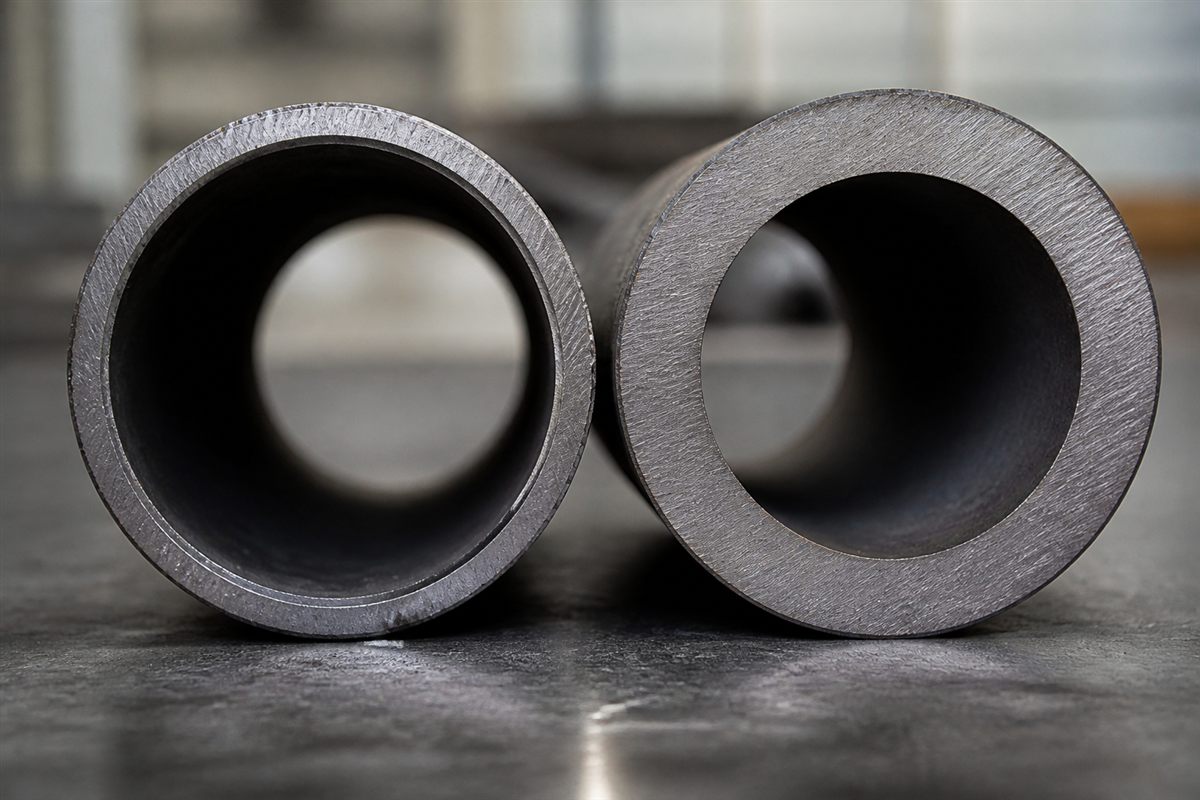
- Constant Outside Diameter (OD): For any given Nominal Pipe Size (NPS), the outside diameter remains completely identical between Schedule 40 and Schedule 80. The extra steel in Schedule 80 is added entirely to the inside, increasing wall thickness while reducing the internal diameter (ID) and flow cross-section.
- Wall thickness differential: Schedule 80 pipe is approximately 25% to 45% thicker than Schedule 40 depending on diameter, significantly increasing internal bursting strength and structural stiffness.
- Weight and procurement cost: Because carbon steel pipe is priced and transported primarily on a per-ton basis, Schedule 80 pipe carries a 25% to 45% higher weight per meter (or foot), directly driving up purchase price, container payload limits, and structural support requirements.
- Pressure performance: Schedule 80 delivers roughly 30% to 50% higher internal working pressure capacity calculated via Barlow’s Formula, making it the default choice for high-pressure hydraulic, chemical process, and steam lines.
- Threading implications: Threading cuts into the outer wall of a pipe by up to 50% of the wall thickness on smaller nominal sizes. While Schedule 80 retains substantial structural wall below the root of the thread, threading Schedule 40 requires strict pressure derating under ASME B31 codes.
What does “Schedule” mean in steel pipe?
The term “Schedule” (abbreviated as Sch.) originates from the standardization work codified in ASME/ANSI B36.10M (Welded and Seamless Wrought Steel Pipe). Prior to schedule numbers, the piping industry relied on three traditional wall thickness designations:
- Standard Weight (STD)
- Extra Strong (XS) or Extra Heavy (XH)
- Double Extra Strong (XXS) or Double Extra Heavy (XXH)
To accommodate expanding chemical processing and high-pressure steam demands, ASME introduced numeric schedule numbers ranging from Schedule 5 through Schedule 160.
In modern commercial practice:
- For pipe sizes from NPS 1/8 through NPS 10, Schedule 40 is identical to Standard Weight (STD).
- For pipe sizes from NPS 1/8 through NPS 8, Schedule 80 is identical to Extra Strong (XS).
- At larger diameters (NPS 12 and above), STD and XS diverge from Schedule 40 and Schedule 80, making exact schedule specification critical.
As detailed in our foundational guide on ASTM A53 vs A106 carbon steel pipe, schedule designations apply equally to both seamless and welded (ERW) manufacturing routes.
Dimensional and weight comparison table: NPS 1/2″ to 24″
The following technical reference table compiles ASME B36.10M dimensions, comparing nominal size, outside diameter, wall thickness, inside diameter, and theoretical plain-end weight for Schedule 40 versus Schedule 80 carbon steel pipe:
| Nominal Pipe Size (NPS) | Outside Diameter (OD) | Schedule 40 Wall Thickness | Schedule 40 Inside Diameter (ID) | Schedule 40 Weight (kg/m / lb/ft) | Schedule 80 Wall Thickness | Schedule 80 Inside Diameter (ID) | Schedule 80 Weight (kg/m / lb/ft) | Weight Increase (Sch 80 vs 40) |
|---|---|---|---|---|---|---|---|---|
| 1/2″ (DN 15) | 21.3 mm (0.840 in) | 2.77 mm (0.109 in) | 15.80 mm (0.622 in) | 1.27 kg/m (0.85 lb/ft) | 3.73 mm (0.147 in) | 13.88 mm (0.546 in) | 1.62 kg/m (1.09 lb/ft) | +27.6% |
| 3/4″ (DN 20) | 26.7 mm (1.050 in) | 2.87 mm (0.113 in) | 20.93 mm (0.824 in) | 1.69 kg/m (1.13 lb/ft) | 3.91 mm (0.154 in) | 18.85 mm (0.742 in) | 2.20 kg/m (1.48 lb/ft) | +30.2% |
| 1″ (DN 25) | 33.4 mm (1.315 in) | 3.38 mm (0.133 in) | 26.64 mm (1.049 in) | 2.50 kg/m (1.68 lb/ft) | 4.55 mm (0.179 in) | 24.30 mm (0.957 in) | 3.24 kg/m (2.17 lb/ft) | +29.6% |
| 1-1/2″ (DN 40) | 48.3 mm (1.900 in) | 3.68 mm (0.145 in) | 40.89 mm (1.610 in) | 4.05 kg/m (2.72 lb/ft) | 5.08 mm (0.200 in) | 38.10 mm (1.500 in) | 5.41 kg/m (3.63 lb/ft) | +33.6% |
| 2″ (DN 50) | 60.3 mm (2.375 in) | 3.91 mm (0.154 in) | 52.51 mm (2.067 in) | 5.44 kg/m (3.66 lb/ft) | 5.54 mm (0.218 in) | 49.25 mm (1.939 in) | 7.48 kg/m (5.03 lb/ft) | +37.5% |
| 3″ (DN 80) | 88.9 mm (3.500 in) | 5.49 mm (0.216 in) | 77.92 mm (3.068 in) | 11.29 kg/m (7.58 lb/ft) | 7.62 mm (0.300 in) | 73.66 mm (2.900 in) | 15.27 kg/m (10.26 lb/ft) | +35.3% |
| 4″ (DN 100) | 114.3 mm (4.500 in) | 6.02 mm (0.237 in) | 102.26 mm (4.026 in) | 16.07 kg/m (10.80 lb/ft) | 8.56 mm (0.337 in) | 97.18 mm (3.826 in) | 22.32 kg/m (15.00 lb/ft) | +38.9% |
| 6″ (DN 150) | 168.3 mm (6.625 in) | 7.11 mm (0.280 in) | 154.08 mm (6.065 in) | 28.26 kg/m (18.99 lb/ft) | 10.97 mm (0.432 in) | 146.36 mm (5.761 in) | 42.56 kg/m (28.60 lb/ft) | +50.6% |
| 8″ (DN 200) | 219.1 mm (8.625 in) | 8.18 mm (0.322 in) | 202.72 mm (7.981 in) | 42.55 kg/m (28.58 lb/ft) | 12.70 mm (0.500 in) | 193.68 mm (7.625 in) | 64.64 kg/m (43.43 lb/ft) | +51.9% |
| 10″ (DN 250) | 273.0 mm (10.750 in) | 9.27 mm (0.365 in) | 254.51 mm (10.020 in) | 60.31 kg/m (40.52 lb/ft) | 15.09 mm (0.594 in) | 242.87 mm (9.562 in) | 95.97 kg/m (64.48 lb/ft) | +59.1% |
| 12″ (DN 300) | 323.8 mm (12.750 in) | 10.31 mm (0.406 in) | 303.22 mm (11.938 in) | 79.73 kg/m (53.57 lb/ft) | 17.48 mm (0.688 in) | 288.90 mm (11.374 in) | 132.08 kg/m (88.63 lb/ft) | +65.7% |
| 16″ (DN 400) | 406.4 mm (16.000 in) | 12.70 mm (0.500 in) | 381.00 mm (15.000 in) | 123.30 kg/m (82.85 lb/ft) | 21.44 mm (0.844 in) | 363.52 mm (14.312 in) | 203.53 kg/m (136.68 lb/ft) | +65.1% |
| 20″ (DN 500) | 508.0 mm (20.000 in) | 15.09 mm (0.594 in) | 477.82 mm (18.812 in) | 183.42 kg/m (123.23 lb/ft) | 26.19 mm (1.031 in) | 455.62 mm (17.938 in) | 311.18 kg/m (208.97 lb/ft) | +69.7% |
| 24″ (DN 600) | 610.0 mm (24.000 in) | 17.48 mm (0.688 in) | 575.04 mm (22.624 in) | 255.41 kg/m (171.29 lb/ft) | 30.96 mm (1.219 in) | 548.08 mm (21.562 in) | 441.85 kg/m (296.22 lb/ft) | +73.0% |
Pressure calculation: Barlow’s formula in action
To understand how schedule thickness translates into pressure capacity, engineers apply Barlow’s Formula, which establishes the mathematical relationship between internal fluid pressure, pipe diameter, wall thickness, and material yield strength:
P = (2 · S · t) / D
Where:
- P = Internal design bursting pressure (psi or bar)
- S = Specified Minimum Yield Strength of the steel grade (psi or MPa)
- t = Nominal wall thickness minus manufacturing tolerances and corrosion allowance (in or mm)
- D = Outside diameter (in or mm)
Practical pressure comparison: 4-inch ASTM A106 Grade B Pipe
Let us calculate the internal bursting pressure of a 4-inch (114.3 mm OD) ASTM A106 Grade B pipe (S = 35,000 psi yield strength):
- Schedule 40 (t = 0.237 in): P = (2 · 35,000 · 0.237) / 4.500 = 3,686 psi (254 bar)
- Schedule 80 (t = 0.337 in): P = (2 · 35,000 · 0.337) / 4.500 = 5,242 psi (361 bar)
In this scenario, stepping from Schedule 40 to Schedule 80 increases the theoretical pressure capacity by 42.2%. For severe operating environments—such as high-pressure steam headers or sour hydrocarbon gas lines under our API 5L line pipe guidelines—that additional 1,556 psi margin provides essential containment safety against pressure spikes and internal corrosion over decades of service.
Flow rate and hydraulic resistance
A critical trade-off frequently overlooked in structural piping is internal cross-sectional area. Because the outside diameter is locked by standard fitting dimensions, increasing wall thickness directly constricts the inner bore:
- On a 2-inch pipe, Schedule 80 reduces internal cross-sectional flow area by 12.1% compared to Schedule 40.
- On a 4-inch pipe, Schedule 80 reduces internal flow area by 9.7%.
- On a 6-inch pipe, Schedule 80 reduces internal flow area by 10.2%.
Procurement takeaway: Specifying Schedule 80 on long-distance cooling water loops or low-pressure transfer lines not only wastes steel tonnage but also permanently increases lifetime pumping energy costs due to higher line friction.
Structural and mechanical differences: bending, span, and threading
Beyond internal pressure, wall thickness governs the pipe’s performance as a structural member or exposed conduit:
1. Bending moment of inertia and pipe span
The structural stiffness of a pipe depends on its second moment of area (I). Schedule 80 pipe features a significantly higher moment of inertia and section modulus (Z), allowing for longer unsupported spans between pipe racks without exceeding allowable mid-span deflection limits.
2. Threading and mechanical joining
When pipes are joined using American National Standard Taper Pipe Threads (NPT), the threading die cuts deep grooves into the pipe wall.
On a 1-inch Schedule 40 pipe with a wall thickness of 3.38 mm (0.133 in), the NPT thread root depth removes roughly 1.4 mm (0.055 in) of steel, leaving less than 60% of the original wall under the thread root.
For threaded high-pressure lines, ASME B31.1 and B31.3 codes mandate Schedule 80 as the minimum wall thickness to ensure sufficient sound metal remains beneath the thread root to resist mechanical fatigue.
Procurement, logistics, and cost analysis
Steel pipe is manufactured, transported, and priced on international commodity markets based on weight (metric tons) rather than linear length. Understanding how schedule dictates tonnage is essential for project estimators and commercial buyers.
1. Raw material purchase price
At equivalent base prices per metric ton:
- A 1,000-meter run of 6-inch Schedule 40 pipe weighs 28.26 metric tons.
- The same 1,000-meter run of 6-inch Schedule 80 pipe weighs 42.56 metric tons.
Choosing Schedule 80 adds 14.3 metric tons (+50.6%) of steel to the bill of materials for that single run.
2. Ocean container freight economics
Standard 40-foot high-cube (40HQ) ocean shipping containers carry a maximum payload limit of approximately 26 to 28 metric tons depending on port and road weight restrictions:
- You can pack approximately 920 meters of 6-inch Schedule 40 pipe into a single container before hitting payload limits.
- You can only pack approximately 610 meters of 6-inch Schedule 80 pipe into the same container.
As highlighted in our analysis of ERW vs Seamless vs LSAW manufacturing economics, pairing the right schedule with the right manufacturing method is the foundation of competitive project bidding.
Decision framework: when to choose Schedule 40 vs Schedule 80
Follow this practical 5-point decision framework to select the correct pipe schedule for your bill of materials:
- Operating pressure and temperature: If calculated working pressure exceeds Schedule 40 limits, select Schedule 80. For ambient to moderate pressure (chilled water, air, drains), select Schedule 40.
- Joining method: For butt-welded or grooved joints, Schedule 40 is standard. For threaded connections with hazardous or high-pressure fluids, specify Schedule 80 minimum.
- Corrosion and erosion allowance: In mildly corrosive chemical lines, Schedule 80 provides a built-in sacrificial corrosion allowance (3.0 mm to 4.5 mm).
- Structural columns and scaffolding: For building columns and warehouse racking, Schedule 40 delivers optimal strength-to-weight ratios. For heavy marine pilings, specify Schedule 80.
- Fire protection systems: Under NFPA 13 rules, wet and dry fire sprinkler distribution grids universally specify Schedule 40.
FAQ
Are the outside diameters of Schedule 40 and Schedule 80 identical?
Yes. For any nominal pipe size (NPS), the outside diameter (OD) is identical across all schedules, allowing standard fittings and flanges to align accurately.
Can you weld a Schedule 40 pipe directly to a Schedule 80 pipe?
Direct butt-welding requires a specialized transition counterbore or internal taper transition (under ASME B16.25) to bridge the wall thickness mismatch and prevent severe stress concentration.
Is Schedule 80 pipe always seamless?
No. Schedule 80 refers strictly to dimensional wall thickness under ASME B36.10M. It is produced in both seamless (ASTM A106, A53 Type S) and electric-resistance welded (ASTM A53 Type E, API 5L) forms.
How does Standard Weight (STD) relate to Schedule 40?
From NPS 1/8 up to NPS 10, Standard Weight (STD) and Schedule 40 have identical wall thicknesses. Above NPS 10, Standard Weight remains fixed at 9.53 mm (0.375 in).
Why is Schedule 80 used for underground road crossings?
Schedule 80 provides higher hoop stiffness and buckling resistance, preventing pipe collapse from heavy vehicular wheel loads and soil overburden.
Does Schedule 80 pipe reduce pump efficiency?
Yes. The thicker wall reduces the internal bore cross-sectional area, which increases fluid velocity and frictional head loss, requiring higher pump discharge pressures.
What is Schedule 160 steel pipe?
Schedule 160 is an ultra-heavy wall designation engineered for extreme high-pressure applications, such as high-pressure steam power cycles and chemical reactors.
How do I check if delivered pipe is Schedule 40 or Schedule 80?
Inspect the physical stencil along the pipe body, verify the heat number against the EN 10204 Type 3.1 Mill Test Certificate, and measure wall thickness at four quadrants using an ultrasonic gauge or vernier calipers.
Bottom line
- Choose Schedule 40 as your default baseline for commercial HVAC, municipal water distribution, fire protection sprinkler grids, and structural steel framing to minimize material and shipping costs.
- Choose Schedule 80 whenever your system operates under elevated pressures, handles hazardous high-temperature steam, relies on cut threaded connections, or requires sacrificial wall thickness against aggressive corrosion.
- Always cross-reference ASME B36.10M dimensional tables during project estimation to verify whether weight-based ocean freight payloads will impact total delivered economics.
For more technical breakdowns of carbon steel specifications, manufacturing methods, and mill quality verification, explore our full library of guides in the Steel Pipe Guide archive.